Immediate difference
Most installations are completed in a single visit and change how safe the house feels the same day.

Service · London & the South East
The cheapest adaptation there is, and the one most often done badly, rails positioned from how the person actually moves, and anchored into structure that will hold their full weight.
Free, no-obligation home assessment · Family-run · 30+ years' experience
Service Overview
A grab rail is a small thing that carries a lot of load. When someone slips, their entire body weight arrives on it in an instant, at an angle nobody planned for. That is why where it is fixed matters as much as where it is placed, and why a rail screwed into plasterboard is worse than no rail at all, it invites trust it cannot repay.
We fit rails, handrails and support fittings throughout the home: beside the toilet, in and out of the shower, along the stairs, at the front door, beside the bed, and at the awkward turn in the hall that everyone in the house already knows about.
Position is set by watching the person move. The height, angle and length come from where their hand naturally reaches and which direction they pull, not from a standard drawing. Fixing comes from finding solid structure or creating it with noggins, pattressing or resin anchors.
It is fast, affordable work, and it is often the highest-value hour anyone spends on a home. We cover London and the South East, and the assessment visit is free with no obligation.
How We Support You
Every rail goes into timber, pattressing or rated anchors and is load-checked, so it feels reassuring under full weight.
Rails placed where people naturally reach mean radiators, basins and door frames no longer have to stand in as supports.
Heights and angles are set to the individual's reach and pull direction, so each rail is genuinely useful.
Rails are one of the fastest, most affordable ways to make a home feel steadier, and they are just as valuable fitted early.
Our Process
We follow the person through the movements that are difficult and note exactly where the hand reaches for something.
We identify studs, noggins, masonry and where reinforcement will need to be added.
Rails held in place and tested by the person before a single hole is drilled, then heights and angles adjusted.
Fixed into structure with appropriate anchors, pattressing added where the wall cannot take the load as built.
Each rail load-tested, then used in the real movement, getting off the toilet, out of the shower, up the stairs.
Benefits
Most installations are completed in a single visit and change how safe the house feels the same day.
The least expensive intervention available against the cost and consequence of a fall.
Into timber, masonry, or added pattressing, never board alone.
Height, angle and length set from their reach and grip, not a catalogue.
No mess, no rooms out of action, no waiting weeks.
Rails available in finishes that suit the room rather than announcing themselves.
In Detail
Bathroom: beside the toilet for sitting and standing, at the shower entry, within reach of the shower seat, and beside the basin where people lean. These are the highest-value positions in the house.
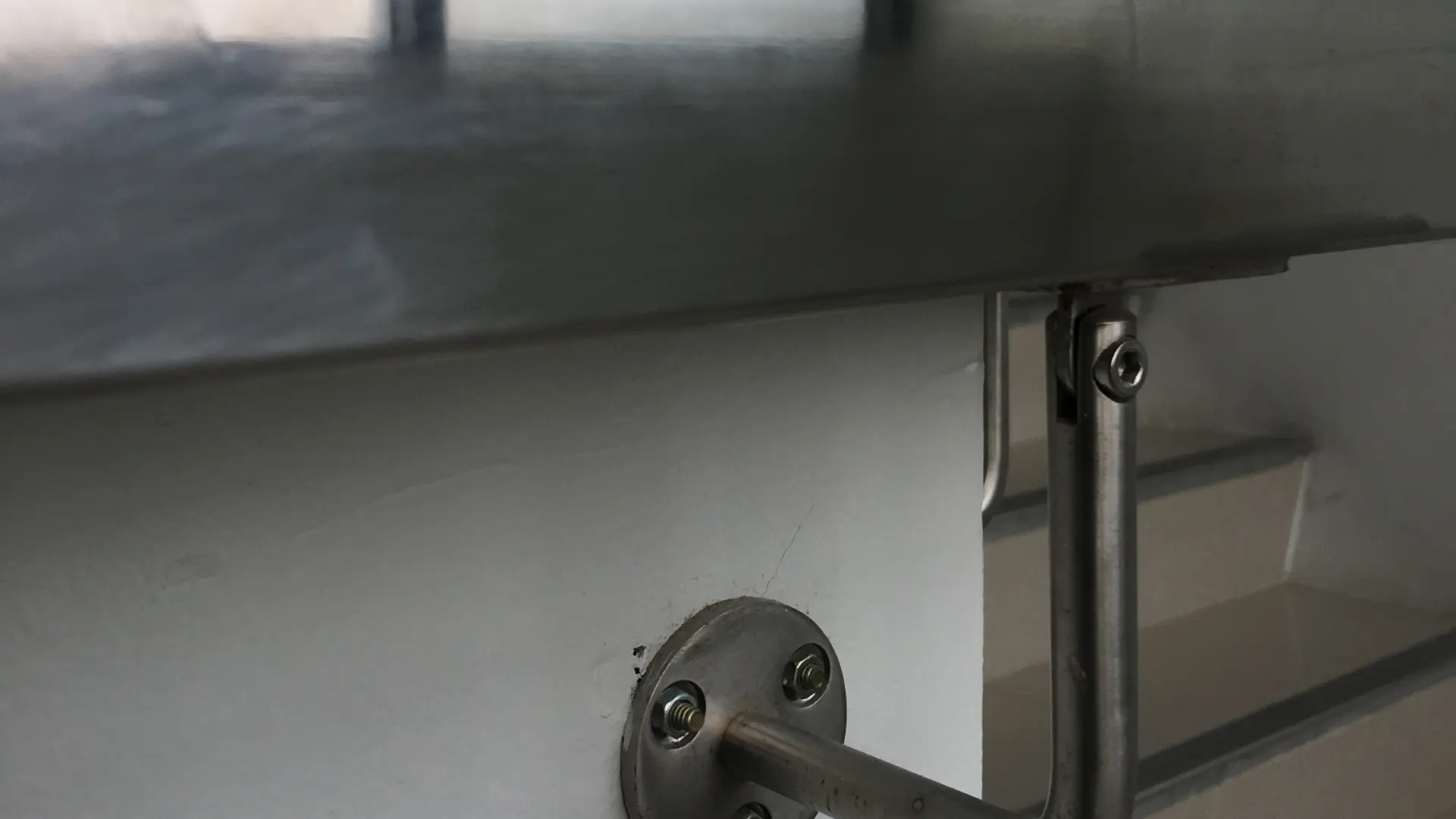
Stairs: a second handrail so both hands can be used, continuous over the full flight, with returns at the ends so sleeves cannot catch, and extended past the top and bottom steps where possible.
Entrances: at the front and back doors, positioned for the pull direction while managing a key, a bag or a frame.
Bedroom and living space: beside the bed for sitting up and standing, and at the chair someone uses most, the two transfers repeated more than any other in the day.
Masonry: mechanical or resin anchors sized for the substrate, avoiding perished mortar joints and set clear of tile edges.
Timber stud walls: fixed into studs where positions allow, or into noggins and plywood pattressing installed behind the board where the required position falls between studs.
Tiled surfaces: pilot-drilled carefully to avoid cracking, with sealing at every penetration so water cannot get behind the tile.
Where a wall genuinely cannot take a rail, we say so and propose an alternative, a floor-to-ceiling pole, a repositioned rail or localised strengthening, rather than fitting something that will fail.
Straight rails for pulling along a route, angled rails for standing from a seated position, and drop-down rails beside toilets where wheelchair access is needed from the side.
Shower seats, fold-down seats and perch stools, all bolted into reinforced structure rather than surface-fixed.
External handrails in galvanised or coated steel for steps and ramped approaches, fixed into the structure or a founded post.
Finishes range from brushed stainless and powder-coated colours to textured grips for weak hands and high-contrast options where vision is limited.
Common Questions
Anything not covered here, ask us directly on 07878 938265.
Related Services
Targeted changes that make everyday tasks easier, safer and more comfortable at home.
Home Adaptations for Independent Living in LondonSlip-resistant, easy-entry bathrooms that keep washing private, dignified and safe.
Accessible Bathroom & Wet Room Installation in LondonFront and back doors made reachable, with gradients and thresholds built to be used every day.
Ramps & Level-Access Threshold Works in LondonBrowse all home adaptation services, see photographs of completed accessibility projects, read about our family-run building team, or check the areas we cover across London and the South East.
Next Step
Send the form and we will come back to you to arrange a visit for your grab rails, handrails & support fittings, or call during opening hours and speak to someone who can help straight away. The assessment is free and there is no obligation.
07878 938265